Are most people using a chainsaw to slice a pizza? You pick the effort, they pick the model. Who picks the bill?
Last week I ran a research task through ChatGPT: YouTube transcripts, web searches and S-1 filings. I turned the model up. Better answer. Tokens gone in short order.
Did I need it? I’m not sure. That is the point.
Three Key Things
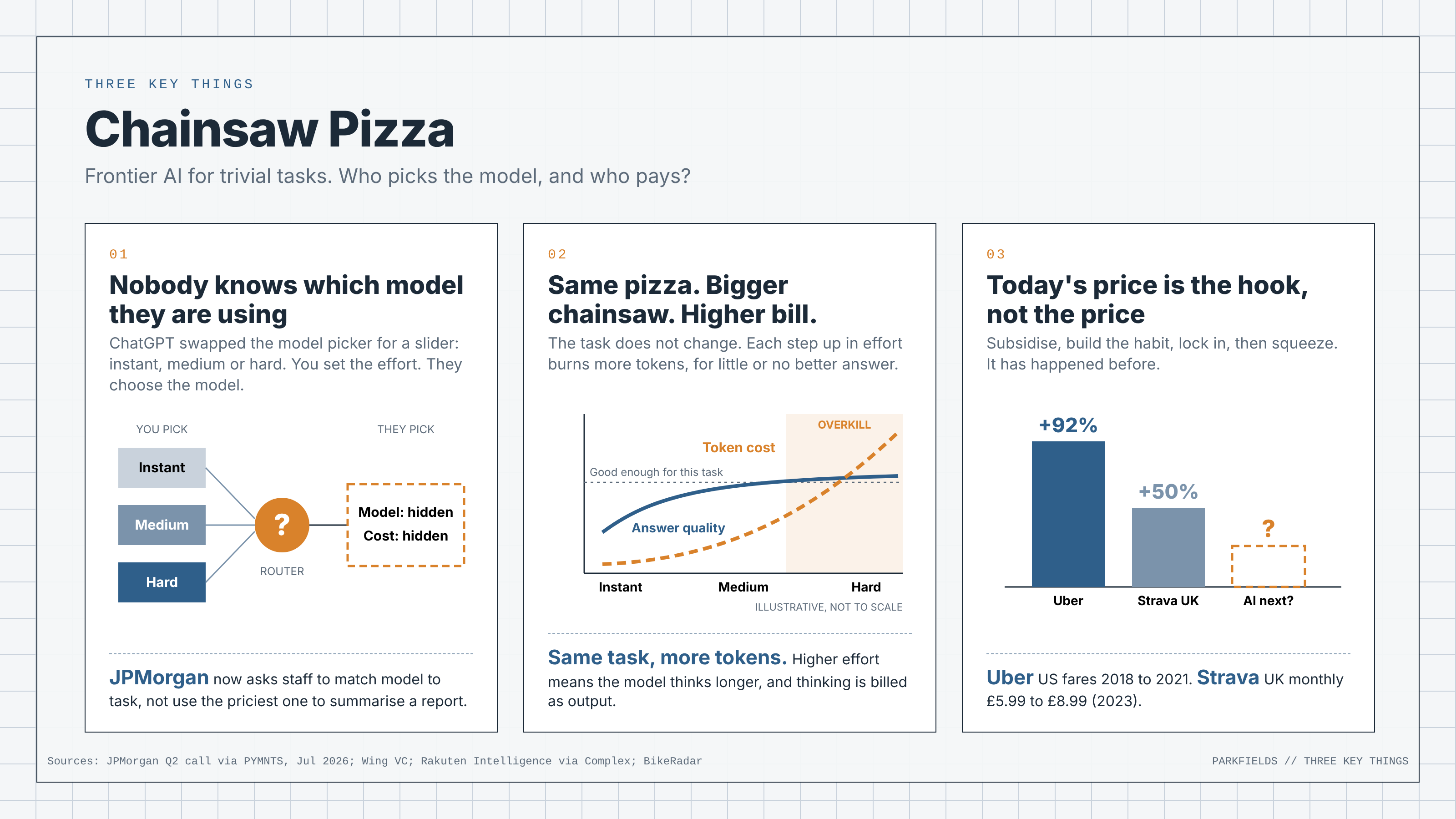
1. Nobody knows which model they are using.
The latest ChatGPT has dropped the model picker for a slider: instant, medium or hard.
I choose the effort. They choose the model. I can’t see what sits behind each setting, or what it costs.
Banks have the same problem at scale. In July, JPMorgan’s CFO told staff to match the model to the task: a report summary does not need the newest, most expensive model. He called first-half token spend trivial, but expects a meaningful rise in the second half.
2. Same pizza. Bigger chainsaw. Higher bill.
The task does not change. Higher effort means the model thinks longer, and thinking is billed as output tokens.
Past “good enough”, the answer barely improves. The cost keeps climbing.
The catch: “good enough” moves with the task. A summary is a pizza cutter. S-1s plus transcripts plus search may need the chainsaw. Nobody shows you where the line sits.
3. Today’s price is the hook.
Uber fares rose 92% from 2018 to 2021 once VC money stopped subsidising rides.
Strava UK monthly went from £5.99 to £8.99.
Google gives me Waze and Gemini for free. I’d pay for those.
My price elasticity is low. That is what the vendors are counting on.
The counterfactual
The better answer may be worth it. If the decision is worth thousands, a pound of tokens is cheap. The real cost is a wrong answer.
AI keeps getting cheaper to run. A fixed level of capability falls in cost roughly 10x a year. Uber’s drivers never did.
Takeaway
Match the effort to the value of the answer, not the size of the question.
Something to think about: when did you last move the slider down?
Sources
JPMorgan on model choice and token costs, Q2 earnings call, 14 July 2026: PYMNTS
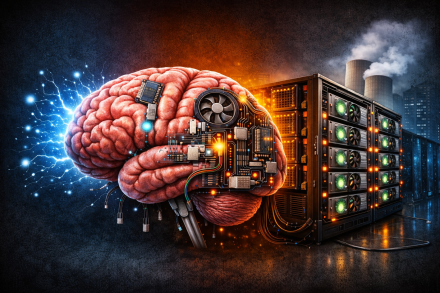
Elon Musk has frequently quipped that humans are essentially “low-watt meat computers.” The human brain runs on roughly 20 watts of power, about the same as a dim lightbulb, yet it delivers perception, memory, creativity, emotional judgment, and real-time motor control with extraordinary reliability. By contrast, modern AI systems require megawatts of electricity, acres of silicon, and industrial cooling.
AI Spending in IT Markets, Worldwide, 2024-2026 (Millions of U.S. Dollars)
Market
2024
2025
2026
AI Services
259,477
282,556
324,669
AI Application Software
83,679
172,029
269,703
AI Infrastructure Software
56,904
126,177
229,825
GenAI Models
5,719
14,200
25,766
AI-optimized Servers (GPU and Non-GPU AI Accelerators)
140,107
267,534
329,528
AI-optimized IaaS
7,447
18,325
37,507
AI Processing Semiconductors
138,813
209,192
267,934
AI PCs by ARM and x86
51,023
90,432
144,413
GenAI Smartphones
244,735
298,189
393,297
Total AI Spending
987,904
1,478,634
2,022,642
Morgan Stanley predicts global data center spending to hit $3 trillion by 2029, with half on construction and half on hardware.
The IEA has a base case that global electricity consumption for data centres is projected to double to reach around 945 TWh by 2030. Their lift-off case projects global electricity demand from data centres in 2035 to be around 45% higher than in the Base Case, exceeding the 1,700 TWh mark and reaching around 4.4% of global electricity demand.
The Economist suggested that if OpenAI raises $100bn in its listing, it would be 4x the largest IPO ever.
Some estimates suggest that AI technology could generate $15.7 trillion in revenue by 2030. Boosting the GDP of local economies by an additional 26%.
Bubble Territory
My holiday reading seemed to focus on where exactly we are in the AI cycle and when the bubble will burst.
Veteran Investor Howard Marks of Oaktree posed sensible questions in his latest memo, “Is it a bubble?’
Who will be the winners, and what will they be worth?
Should we worry about so-called “circular deals”?
What will be the useful life of AI assets?
Is exuberance leading to speculative behavior?
What’s the end state?
“Many companies justify their spending because they’re not just building a product, they’re creating something that will change the world: artificial general intelligence, or A.G.I. . . . The rub is that none of them quite know how to do it.”
For deeper and more skeptical analysis, Ed Zitron’s newsletter is a cracking read. Basically, enterprises are trying to adopt generative AI, but it doesn’t work.
To be skeptical of AI is to commit yourself to near-constant demands to prove yourself, and endless nags of “but what about?” with each one — no matter how small — presented as a fact that defeats any points you may have.
He kicks off this post with a MIT report by Mit Nanda (it is a little old given it was published in July 2025) which concludes 95% of organizations are getting zero return [on generative AI].” The report says that “adoption is high, but transformation is low,” adding that “…few industries show the deep structural shifts associated with past general-purpose technologies such as new market leaders, disrupted business models, or measurable changes in customer behavior.”
Three Key Things:
Both at work and personally, AI has been both a massive productivity tool and slightly disappointing in a more prescriptive, constrained environment. However, I have high hopes.
I expect that, as with any super cycle, many projects and their hype will never be delivered.
I’m particularly interested in the future of robotics using AI systems. Check out Hannah Fry’s visit to the Google Robotics Lab.
A comedian was asked a question in an interview. She paused, looked skyward, and replied:
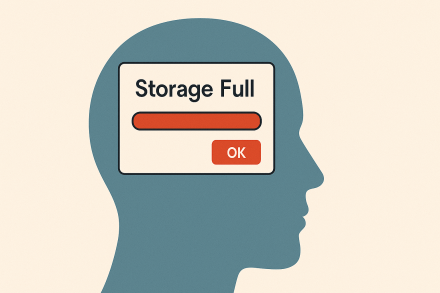
“Oops… my storage is full.”
Maybe, like her, I’ve started sending thoughts to the delete box in my brain to make room for new ones. Unfortunately, my devices don’t have that instinct. Instead, they politely send me monthly invoices for keeping thousands of barely looked at files alive in the cloud.
The Digital Attic We’re All Building
The cloud has become a kind of digital attic, out of sight, out of mind, but continually accruing rent.
Most of us now run sprawling personal archives across multiple platforms. We rarely think about it until a “storage full” message forces us to act.
Are We Paying Rent on Our Memories?
The Real Costs: Economic and Environmental
For individuals, the economics of storage are subtle but real. Most services offer a generous “starter” tier, then quietly raise prices as your data grows. A few pounds or dollars per month here and there doesn’t feel like much, but over a decade across multiple services, you might spend hundreds (or thousands) of pounds or dollars keeping dusty data sitting on remote servers.
For companies like Apple, Google and Dropbox, this is gold dust: a predictable, sticky revenue stream built on our reluctance to delete. We may not use the service actively, but we daren’t turn it off.
Then there’s the environmental angle. Data feels intangible, but storage is intensely physical. Every image, playlist and PDF lives on servers in vast data centres that consume enormous amounts of electricity and water for cooling.
Forgetting Is a Feature, Not a Bug
Our brains evolved to forget. We filter, compress, and discard constantly, not because we’re inefficient, but because it’s necessary to function. Digital systems don’t work like that. They remember everything, forever, unless we explicitly tell them not to. And we rarely do.
Culturally, this is new. Previous generations kept a shoebox of photos or a few treasured letters. We keep entire lives in cloud folders, half of which we’ll never look at again. There’s a strange comfort in knowing it’s all “there,” but also a cognitive weight, like having a messy spare room you never enter but always know needs tidying.
Future Shock: The Rising Tide of Useless Data
Looking ahead, a few scenarios could make this issue more than just a personal nuisance: 1. Storage costs may rise: Economic or regulatory pressures could push cloud providers to increase prices, making our digital hoarding suddenly expensive. 2. Data curation could become a profession: Just as archivists preserve historical records, future “personal digital archivists” might help individuals decide what’s worth keeping. In HK, I paid to convert 35mm pictures to digital and VCR to MP4. 3. AI summarisation and auto-deletion: Smart tools could eventually audit your archives, extract key content, and safely dispose of the rest — like an intelligent housekeeper. 4. Inheritance headaches: Unmanaged data estates could leave families with vast, unorganised digital troves to sort through — part time capsule, part landfill.
In a sense, we’re the first generation to face this problem at scale. Previous eras worried about physical clutter; we’re dealing with information clutter on an industrial scale.
AI slop only adds to the digital landfill.
The Case for Selective Forgetting
There’s something almost philosophical here. If forgetting is part of what makes us human, part of how we prioritise, grow, and move forward, maybe our digital lives should mirror that. Not everything needs to be saved forever. Some things should fade, quietly and gracefully.
We’ve mastered saving everything. What we haven’t mastered is deciding what’s worth keeping.
As I write this, my phone is backing up thousands of photos I’ll probably never look at. Maybe the most innovative future feature isn’t “More Storage” but a well-designed “Forget” button.
We used to curate photo albums; now we dump images into clouds. We once treasured mixtapes; now we build playlists we never revisit. Perhaps it’s time to think less like hoarders and more like editors.
Three Key Things
Digital clutter has real costs — our endless photo rolls and cloud folders aren’t free; they generate both financial fees and environmental impact. Forgetting is healthy — human memory evolved to filter; our digital lives haven’t caught up, creating cognitive overload and anxiety. Curation is the new intelligence — the future belongs to those (and those tools) who can decide what’s worth keeping, not just what can be stored.
How do you communicate with an audience you can’t imagine?
💀 Welcome to Nuclear Semiotics
Deep geological nuclear storage sites have to stay secure — and understood — for up to 100,000 years.
That’s longer than any civilisation (China leads at ~5,000 years), language, or brand has ever lasted.
Governments and scientists are grappling with a surprisingly difficult question:
What sign would warn future humans — or whoever finds it — to stay away?
The nuclear challenge is to resist reinterpretation for millennia. The branding challenge is the opposite — to evolve fast enough to stay relevant.
Even the skull-and-crossbones, once a universal warning, has become everything from fashion to treasure maps. Meaning is slippery.
🧠 Designing Warnings for Deep Time
Several national programmes — notably the U.S. Waste Isolation Pilot Plant (WIPP) and conceptual work in Europe — have commissioned archaeologists, linguists, semioticians, artists, and engineers to imagine warnings that can endure for 10,000+ years.
🏜 Foreboding physical forms to immediately signal danger
🧠 Pictographic warnings to convey “poison” or “death”
📜 Text or maps for the future intelligentsia who might decipher them
But:
Symbols decay. Languages shift.
🔄 The Branding Parallel
Brands also live — and sometimes die — by their ability to communicate across shifting cultural landscapes.
Some remain recognisable for over a century; others reinvent to survive.
Both nuclear engineers and brand strategists face opposite versions of the same puzzle:
Nuclear Storage
Branding
❄️ Freeze meaning for millennia so it’s not misunderstood
🌀 Evolve meaning to keep pace with fast-changing media & culture
Both confront the same truth: meaning isn’t permanent.
Our clearest messages are just temporary graffiti on a very long wall.
🌐 Tech Titans & Strategic Rebrands
Some of the most visible brand shifts of the past decade came from Big Tech — restructuring names and identities to signal strategic pivots, not just visual evolution:
Old
New
Year
Why
Facebook
Meta
2021
Pivot to “metaverse” vision
Google
Alphabet
2015
Corporate restructuring to separate core and “moonshots”
Square
Block
2021
Expansion beyond payments into crypto and ecosystem
Twitter
X
2023
Ambitious repositioning as “everything app”
These weren’t aesthetic tweaks — they were strategic semiotic resets.
🔁 Famous Brand Reversals
Some experiments don’t stick — forcing brands to revert to something more familiar:
Original
Rebrand
Year
Outcome
Standard Life Aberdeen
abrdn
2021
Widely mocked; partial reversal by 2024
Royal Mail
Consignia
2001
Lasted 16 months; reverted after backlash
Coca-Cola
New Coke
1985
Reintroduced “Classic” within 3 months after public outcry
Gap
Helvetica logo
2010
Reverted within a week due to ridicule
👉 Brand equity, cultural familiarity, and consumer attachment often run deeper than strategists expect.
☢️ If You Want to Go Nuclear
In a previous article I looked at projects that overrun budgets and timelines. Nuclear storage sits at the very top of that list.
Finland is furthest ahead with Onkalo — the world’s first operational deep geological repository.
Burying nuclear waste is considered a “final disposal” solution, designed to remain undisturbed for up to 500,000 years, surviving ice ages, tectonic shifts, earthquakes and sea level rise.
“Most people overestimate what they can do in one year and underestimate what they can do in ten years.” Bill Gates
As we wrap up another lap of the Earth’s orbital period around the Sun, it is hard not to slip in some reflection and forecasting.
Forecasting is more sport than science in the finance world despite the headlines a convincing forecast creates. Bloomberg quantified the hope and reality of S&P 500 Index Forecasting.
The average forecast of brokers is for a 9.1% gain in 2025.
Over the last 25 years, 53% of the 376 firms surveyed clustered between 0 and 10%.
However, the actual distribution of returns is much more volatile, with only 15% of the last 25 years posting 0-10% returns.
Over a longer period, large gains and losses were more frequent than single-digit gains, which occurred just 14 times in 97 years.
57% of all forecasts analyzed were less than the actual market returns, while 43% proved to be too high.
So, I’m not making any forecasts, but I am anchoring myself to Bill Gates’s comment and will focus on starting a few new things and making some forward progress while not critically watching the hours, weeks, and months pass by. Hopefully, I will be surprised at what I can achieve in time.
To quote the insightful Alan De Botton “Work begins when the fear of doing nothing at all finally trumps the terror of doing it badly.”
If you need more perspective, check out his excellent resources at The School of Life or some of his best one liners.
Support your local Air Ambulance.
One hundred thirty days ago, I fell off my gravel bike in the hills, breaking my femur. I’m back on the bike for the first time post-op. Leaving the hospital on crutches with metalwork in my leg, I was optimistic about my recovery time. It turns out the experts were correct, and my over-optimism is now more aligned with reality. My plan is to surprise myself with what I can achieve in the longer term while doing the recovery work in the short term.
I’m closing out this year with no regrets and high expectations. Onwards.