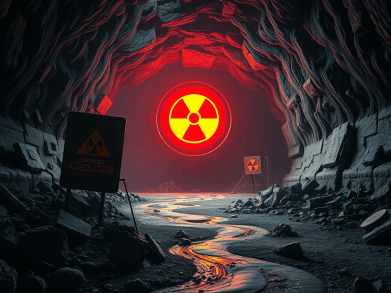
How do you communicate with an audience you can’t imagine?
💀 Welcome to Nuclear Semiotics
Deep geological nuclear storage sites have to stay secure — and understood — for up to 100,000 years.
That’s longer than any civilisation (China leads at ~5,000 years), language, or brand has ever lasted.
Governments and scientists are grappling with a surprisingly difficult question:
What sign would warn future humans — or whoever finds it — to stay away?
The nuclear challenge is to resist reinterpretation for millennia.
The branding challenge is the opposite — to evolve fast enough to stay relevant.
Even the skull-and-crossbones, once a universal warning, has become everything from fashion to treasure maps. Meaning is slippery.
🧠 Designing Warnings for Deep Time
Several national programmes — notably the U.S. Waste Isolation Pilot Plant (WIPP) and conceptual work in Europe — have commissioned archaeologists, linguists, semioticians, artists, and engineers to imagine warnings that can endure for 10,000+ years.
This field is known as nuclear semiotics.
A 1993 Sandia Labs report recommended a layered messaging strategy:
- 🏜 Foreboding physical forms to immediately signal danger
- 🧠 Pictographic warnings to convey “poison” or “death”
- 📜 Text or maps for the future intelligentsia who might decipher them
But:
Symbols decay. Languages shift.
🔄 The Branding Parallel
Brands also live — and sometimes die — by their ability to communicate across shifting cultural landscapes.
Some remain recognisable for over a century; others reinvent to survive.
Both nuclear engineers and brand strategists face opposite versions of the same puzzle:
| Nuclear Storage | Branding |
|---|---|
| ❄️ Freeze meaning for millennia so it’s not misunderstood | 🌀 Evolve meaning to keep pace with fast-changing media & culture |
Both confront the same truth: meaning isn’t permanent.
Our clearest messages are just temporary graffiti on a very long wall.
🌐 Tech Titans & Strategic Rebrands
Some of the most visible brand shifts of the past decade came from Big Tech — restructuring names and identities to signal strategic pivots, not just visual evolution:
| Old | New | Year | Why |
|---|---|---|---|
| Meta | 2021 | Pivot to “metaverse” vision | |
| Alphabet | 2015 | Corporate restructuring to separate core and “moonshots” | |
| Square | Block | 2021 | Expansion beyond payments into crypto and ecosystem |
| X | 2023 | Ambitious repositioning as “everything app” |
These weren’t aesthetic tweaks — they were strategic semiotic resets.
🔁 Famous Brand Reversals
Some experiments don’t stick — forcing brands to revert to something more familiar:
| Original | Rebrand | Year | Outcome |
|---|---|---|---|
| Standard Life Aberdeen | abrdn | 2021 | Widely mocked; partial reversal by 2024 |
| Royal Mail | Consignia | 2001 | Lasted 16 months; reverted after backlash |
| Coca-Cola | New Coke | 1985 | Reintroduced “Classic” within 3 months after public outcry |
| Gap | Helvetica logo | 2010 | Reverted within a week due to ridicule |
👉 Brand equity, cultural familiarity, and consumer attachment often run deeper than strategists expect.
☢️ If You Want to Go Nuclear
In a previous article I looked at projects that overrun budgets and timelines. Nuclear storage sits at the very top of that list.
Finland is furthest ahead with Onkalo — the world’s first operational deep geological repository.
Burying nuclear waste is considered a “final disposal” solution, designed to remain undisturbed for up to 500,000 years, surviving ice ages, tectonic shifts, earthquakes and sea level rise.
- Secrets of the deep, deep tunnels where nuclear waste is buried – BBC
- Storage and Disposal of Radioactive Waste – World Nuclear Association

✍️ Final Thought
Whether you’re designing a warning for 100,000 years in the future or repositioning a global brand, the problem is the same:
How do you communicate with an audience you can’t imagine?
Leave a Reply